
.
United Nations Inter-Agency Task Force on NCDs (UNIATF)
The Secretariat of the WHO FCTC and UNIATF
Since 2013, the Convention Secretariat has been an independent member of UNIATF and ensures that implementation of the WHO FCTC remains a key focus.
Videos








.tmb-549v.jpg?Culture=en&sfvrsn=fa0e5881_1)


Latest events
News
Resources
Debunking Tobacco Industry Misinformation
The tobacco industry will go to great lengths to avoid, delay or undermine progress. The right to health is a fundamental responsibility of the state. However, big tobacco companies seek to maintain lax policy environments, and often employ interference tactics, for example, creating industry-backed ‘front groups’ of consumers or farmers to obstruct progressive tobacco control legislation. Experiences in many countries prove that contrary to industrybiased forecasts, tobacco control action can raise government revenue, help businesses, improve livelihoods and increase employment overall.
Testing of tobacco and related products
The importance of laboratory testing of tobacco products is reflected in the World Health Organization Framework Convention on Tobacco Control (WHO FCTC). Article 9 of the WHO FCTC defines obligations for Parties with respect to the testing of tobacco products, while Article 10 deals with the disclosure of information on the contents and emissions of tobacco products. The disclosure of product information encompasses the disclosure of information by manufacturers to regulators and disclosure of information from regulators to the public. Testing of tobacco products is needed to generate the data necessary to support both these forms of disclosure.
Status of tobacco production and trade in Africa
In 2018 alone, over 3.5 million hectares of land were harvested for tobacco. Tobacco growing is destroying our environment and threatening our health. As regulations tighten in middle- and high- income countries, tobacco companies are increasingly targeting African countries to scale-up tobacco leaf production. In Africa, tobacco crop yields increased by 10% from 2012 to 2018. Its impact is felt far beyond the 8 million people it kills with disease every year it also threatens the Earth’s resources, contributes to poverty, and exposes tobacco farmers to health risks. Farmers are often trapped in arrangements that lead to a vicious circle of debt, unable to get a fair price for their product. On top of that children from poor households miss school to be employed in tobacco farming to boost the family income.
The tobacco body
Tobacco is deadly in any form. Smoked tobacco products, including waterpipes, contain over 7000 chemicals, including at least 250 chemicals known to be toxic or to cause cancer. Use of smokeless tobacco products can result in serious – sometimes fatal – health problems. Exposure to second-hand smoke has also been implicated in adverse health outcomes, including death. Newer tobacco products contain similar chemicals to traditional tobacco products and are harmful to health.
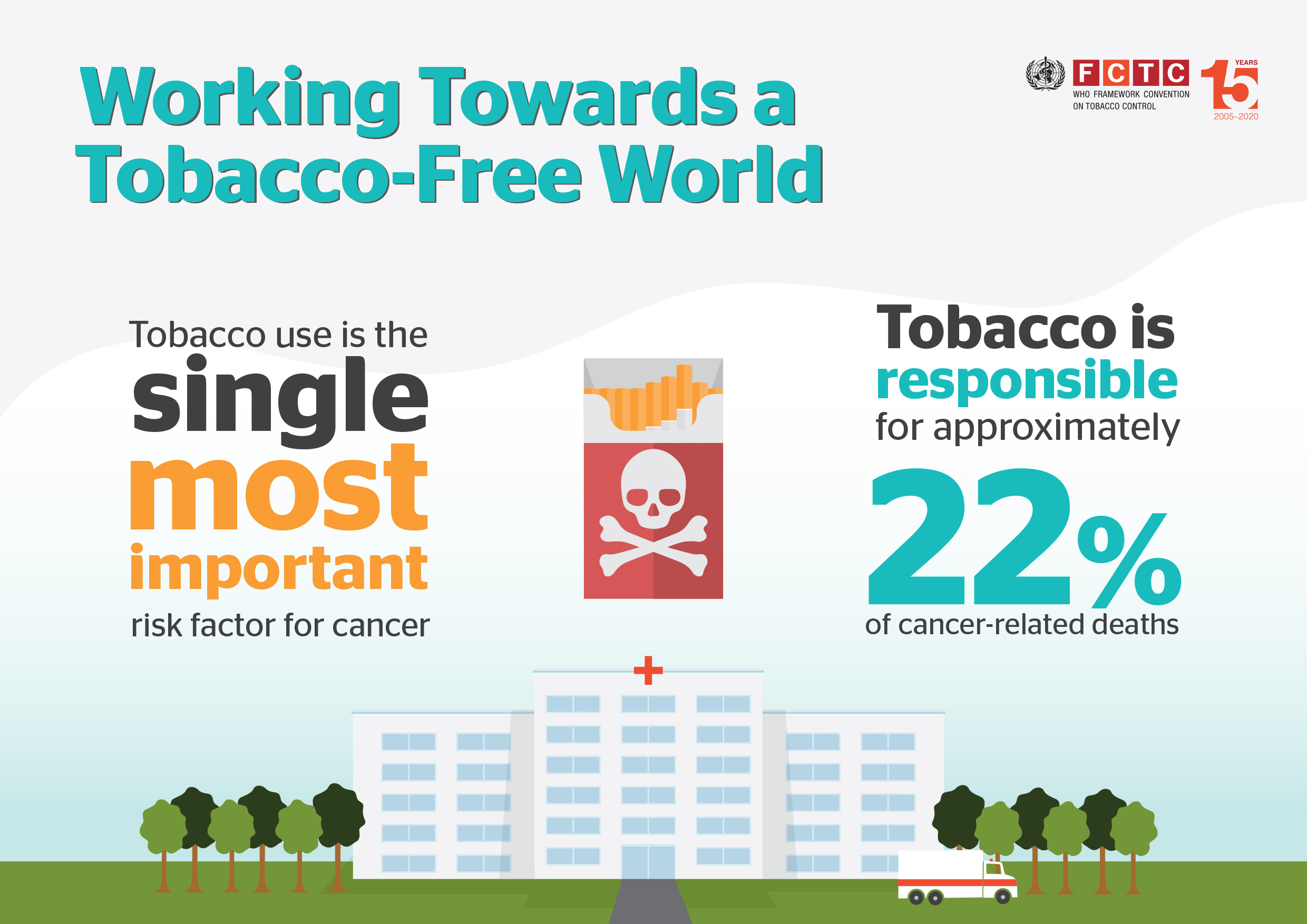
Lifelong tobacco smokers lose at least 10 years of life on average. Globally, over 22 000 people die from tobacco use or second-hand smoke exposure every day — one person every 4 seconds. The Tobacco Body poster visually depicts the various ways tobacco use harms almost every organ of the human body.
Litigation relevant to regulation of novel and emerging nicotine and tobacco products: Comparison across Jurisdictions
Novel and emerging nicotine and tobacco products have presented a number of challenges for regulators in recent years, including the risk that regulation may lead to litigation. This paper analyses litigation concerning tobacco product regulation across jurisdictions, with the aim of highlighting the legal arguments advanced and the reasoning of courts relevant to novel and emerging nicotine and tobacco products. In this regard, 89 cases between 2008-2020 were identified as relevant. The objective of this paper is to assist the Member States to achieve a high level of health protection in the context of novel and emerging products through a discussion on the legal challenges arising globally.
Litigation relevant to regulation of novel and emerging nicotine and tobacco products: case summaries
Novel and emerging tobacco products have presented a number of challenges for regulators, including the risk that regulation may lead to litigation. The report titled ‘Litigation Relevant to Regulation of Novel and Emerging Nicotine and Tobacco Products’ analyses litigation concerning tobacco and nicotine product regulation across jurisdictions, with the aim of highlighting the legal arguments advanced and the reasoning of courts relevant to novel and emerging nicotine and tobacco products. In this regard, 89 cases between 2008-2020 were identified as relevant.
The report identifies two broad categories of litigation. The first concerns measures addressing product characteristics and disclosures. This group of cases concerns legal challenges against measures which prescribe the form that a product may or may not take, including, classification of these products under national legislation, proportionality of product prohibitions, and flavour bans. The second category of cases concerns health claims and advertising, promotion and sponsorship. These concern application of laws to different products, including enforcement actions concerning misleading conduct and restrictions on advertising, promotion, and sponsorship.
This document contains summaries of the cases identified as relevant, including those described in the report. This document describes the facts, legal issues, arguments advanced, and reasoning of the courts.
WHO study group on tobacco product regulation: Report on the scientific basis of tobacco product regulation: eighth report of a WHO study group
This report of the WHO Study Group on Tobacco Product Regulation provides the Director-General with scientifically sound, evidence-based recommendations for Member States about tobacco product regulation. The outcomes and recommendations address a number of issues concerning novel and emerging nicotine and tobacco products, such as electronic nicotine delivery systems (ENDS), electronic non-nicotine delivery systems (ENNDS) and heated tobacco products (HTPs) and improves understanding of Member States on these products.
The study group reviewed nine background papers and two horizon scanning papers, specially commissioned for its tenth meeting, which addressed the following topics:
- Toxicants in HTPs, exposure, health effects and claims of reduced risk (section 2);
- The attractiveness and addictive potential of HTPs: effects on perception and use and associated effects (section 3);
- Variations among HTPs, considerations and implications (section 4);
- Use of HTPs: product switching and dual or poly product use (section 5);
- Regulations on HTPs, ENDS and ENNDS, with country approaches, barriers to regulation and regulatory considerations (section 6);
- Estimation of exposure to nicotine from use of ENDS and from conventional cigarettes (section 7);
- Exploration of methods for quantifying individual risks associated with ENDS, ENNDS and HTPs: impact on population health and implications for regulation (section 8).
- Flavours in novel and emerging nicotine and tobacco products (section 9);
- Global marketing and promotion of novel and emerging nicotine and tobacco products and their impacts (section 10);
- Forms of nicotine in tobacco plants, chemical modifications and implications for ENDS products (section 11); and
- EVALI: “e-cigarette or vaping product use-associated lung injury” (section 12).
The Study Group’s recommendations seek to promote international coordination of regulatory efforts, the adoption of best practices in product regulation and strengthen product regulation capacity-building across all WHO regions. This report is a ready resource to Member States, based on sound science and support the implementation of the WHO Framework Convention on Tobacco Control (WHO FCTC) by its States Parties.
The report, which is a WHO global public health good will complement the global efforts to strengthen the implementation of WHO FCTC (target 3a of the Sustainable Development Goals), thereby helping reduce tobacco use and improve overall public health at country, regional and global level.
Each chapter of the report has been summarized for regulators to support policy action at country level based on the evidence-based recommendations of the report. These summaries, which are derivative products of the TRS, will be published shortly.”
WHO report on the global tobacco epidemic 2021: addressing new and emerging products
The eighth WHO report on the global tobacco epidemic tracks the progress made by countries in tobacco control since 2008 and, for the first time, presents data on electronic nicotine delivery systems, such as ‘e-cigarettes’. The report shows that many countries are making progress in the fight against tobacco, but some are not addressing emerging nicotine and tobacco products and failing to regulate them.
WHO report on the global tobacco epidemic, 2021: addressing new and emerging products: executive summary
Since publication of the first WHO report on the global tobacco epidemic in 2008, the steady progress made by countries on tobacco control has been demonstrated in biennial updates, of which this report is the latest. Despite the exceptional challenges brought on by the COVID-19 pandemic in 2020, that progress continues.
It’s time to invest in cessation: the global investment case for tobacco cessation
The Global Investment Case for Tobacco Cessation outlines the health and economic benefits from investing in evidence-based interventions to support tobacco cessation in low- and middle-income countries. The goal is to provide policymakers, donors, advocates, and other relevant stakeholders with a sound and evidence-based economic case for investing in and scaling up these measures.
WHO global report on trends in prevalence of tobacco use 2000-2025, fourth edition
Progress in reducing tobacco use is a key indicator for measuring countries’ efforts to implement the WHO Framework Convention on Tobacco Control – target 3.a under the Sustainable Development Goals agenda. Countries have adopted this indicator to report progress also towards the tobacco reduction target under the Global Action Plan for the Prevention and Control of Noncommunicable Diseases 2013–2020 and the WHO’s Global Programme of Work triple billions target. This report presents WHO estimates of tobacco use prevalence for 2020, numbers of users, and trends projected to 2025. Estimates are at global, regional and country-level.
It’s time to invest in cessation: the global investment case for tobacco cessation. Methodology and results summary
This document outlines the methodology used in analyzing the return on investment of selected tobacco cessation interventions, as detailed in the report It’s time to invest in cessation: the global investment case for tobacco cessation. It also provides a summary of the results and includes the sources and studies used in the analysis.
Information sheet: measuring priority emissions in heated tobacco products, importance for regulators and significance for public health
Heated tobacco products (HTPs) are a re-emerging class of tobacco products that present regulatory challenges in many countries. One of such challenges is the lack of standardized analytical testing methods for HTPs, which are devoid of tobacco industry involvement. This information sheet was prepared in response to calls from Member States, to WHO, to provide guidance on the testing of the priority contents and emissions of these products. It provides useful information on the priority emissions in HTPs to a wide range of stakeholders including policy makers, regulators, scientists, non-governmental organizations, and all WHO regional and country offices, and makes the case for their regulation. It also highlights the public health significance of measuring priority emissions and specifically addresses the following questions:
- What are heated tobacco products?
- Why measure and regulate tobacco products?
- Why measure and regulate HTP emissions?
- Which HTP emissions should be measured as priorities for regulation?
- What TobLabNet methods are available for measuring priority chemicals in HTP emissions?
- What can regulators do to support method development by TobLabNet?
- References
HTPs were recognized as tobacco products at the Eighth Session of the Conference of the Parties to the WHO Framework Convention on Tobacco Control and the provisions of the WHO FCTC fully apply, including Articles 9 and 10 of the WHO FCTC. Therefore, this information sheet contributes to the knowledge on HTPs and will help guide countries interested in testing and regulating the emissions of HTPs, in order to strengthen implementation of Articles 9 and 10 of the WHO FCTC.
Report of the meeting to review the latest scientific evidence on the impact of cigarette ventilation on cigarette use, 18–19 November 2019
This report provides an overview of the deliberations and findings of the face-to-face meeting on cigarette ventilation to gain an overview of the latest scientific evidence on the impact of cigarette ventilation on cigarette use from 18 – 19 November, 2019. The meeting, which was held in line with request 8 of Decision FCTC/COP8(21), addressed the following topics related to cigarette ventilation:
- introduction to cigarette ventilation and possible implications for public health;
- exploration of cigarette ventilation mechanisms, market availability and prevalence of use;
- potential effects of cigarette ventilation on human smoking topography and behaviour;
- effects of cigarette filter ventilation on machine-measured yields;
- effects of cigarette ventilation on product appeal and consumer perception/use;
- exploration of potential health effects of filter ventilation on consumers; and
- regulatory and policy considerations for ventilated cigarettes.
The report summarizes the findings of the meeting, provides useful information on the strength of evidence of the findings, the research gaps and regulatory considerations and provides some recommendations. Thus, it contributes to the knowledge on cigarette ventilation, improves countries’ understanding of the use of ventilation in cigarettes and could help in strengthening the implementation of Articles 9 and 10 of the WHO FCTC.
Tobacco Plain Packaging in Australia
In 2011, the Australian Government introduced plain packaging as part of a comprehensive suite of new and existing tobacco-control measures. The plain packaging measures fully standardized the appearance of tobacco products and their retail packaging. It prohibited the use of certain trademarks and other marks to be used on tobacco products and their packaging (e.g. stylized word marks, composite marks and figurative marks) and permitted the brand, company, or business name and the variant name of the tobacco product to be printed only in a typeface, colour, style and font size prescribed by the regulations. These measures were challenged before the World Trade Organization (WTO) on the ground that they were inconsistent with the Agreement on Technical Barriers to Trade (TBT Agreement) and the Agreement on Trade-Related Aspects of Intellectual Property Rights (TRIPS Agreement). The Panel dismissed all the claims brought by the complainants and the Appellate Body upheld its findings.
The Appellate Body’s affirmation of the legality of Australia’s plain packaging measures means that countries are likely to follow suit in implementing similar measures, and that they may do so with confidence about the legal status of those measures under WTO law.
Tobacco: poisoning our planet
Tobacco use is a well-documented threat to global health, and in the area of tobacco control, extensive work has been done to communicate the health risks of tobacco use and to reduce the demand for tobacco through effective policy interventions. What has been less discussed or documented are the environmental health risks of tobacco cultivation, production, distribution, consumption and waste. The harmful impact of the tobacco industry on the environment is vast and growing, and has thus far received relatively little attention from researchers and policy-makers.
The environmental consequences of tobacco use move it from being a human problem to a planetary problem. It is not just about the lives of tobacco users and those around them, or even those involved in tobacco production. Tobacco can no longer be categorized simply as a health threat – it is a threat to human development as a whole.
Tobacco plain packaging: global status 2021 update
Plain (or standardized) packaging is defined as “measures to restrict or prohibit the use of logos, colours, brand images or promotional information on packaging other than brand names and product names displayed in a standard colour and font style”.
In 2018, WHO published a Global status update outlining the first wave of countries that implemented plain packaging, and how they did so. This update outlines how the second wave of countries i.e. Belgium, Canada, Denmark, Israel, Myanmar, Netherlands, Saudi Arabia, Singapore, Slovenia, Thailand, and Türkiye are implementing plain packaging relative to the first wave. Since the finalization of this publication, Georgia and Mauritius have issued regulations to implement plain packaging by end of 2022. Armenia, Botswana, Cote d’Ivoire, and Finland have also amended their legislation to implement plain packaging. This should give other countries a push to follow suit with confidence about the legal status and impact of plain packaging.
Healthier populations and noncommunicable diseases: biennium report (2020–2021)
World Health Organization. Regional Office for South-East Asia. (2022). Healthier populations and noncommunicable diseases: biennium report (2020–2021). World Health Organization. Regional Office for South-East Asia.
Pacific tobacco industry interference index: a tool for monitoring the types and extent of tobacco industry interference
Information regarding the implementation of the recommendations of the Article 5.3 Guidelines across the Pacific island countries is limited and has yet to be measured systematically. The Pacific Tobacco Industry Interference (TII) Index was developed by the Tobacco Free Pacific 2025 Alliance, with support from the Framework Convention Alliance and WHO, as a tool for governments and nongovernmental organizations (NGOs) to monitor the types and extent of industry interference in their countries, and to assess how well prepared governments are to prevent it.
Tobacco industry interference in the Pacific is often poorly monitored and recognized, and this tool simplifies the issue by providing a systematic way of doing both. Unlike the Global Tobacco Industry Interference Index, this tool is not intended to categorize the severity of tobacco industry interference within countries based on the scores. However, it does recommend strategies for preventing it.
Using the Pacific TII Index on a regular basis (e.g., every two years) and/or designating an entity to oversee the monitoring of tobacco industry interference may help strengthen a government’s ability to protect public health interests from such interference.
World No Tobacco Day 2023: grow food, not tobacco
The world is confronted with a global food crisis fuelled by conflict, climate change and the COVID-19 pandemic. Meanwhile, tobacco is grown in over 124 countries, taking up millions of hectares of fertile land that could be used to grow food, address food security and nutrition challenges and help feed families. Tobacco growing also has serious health impacts on tobacco farmers due to heavy use of pesticides and high absorption of nicotine through the skin.
Furthermore, tobacco farmers often find themselves trapped in a vicious cycle of debt as a result of unfair contractual agreements with the tobacco industry and face difficulties in shifting away from tobacco. Fortunately, there are several examples of successful transitions where tobacco farmers have switched to growing high-iron beans, cashew, corn and green vegetables instead. In order to achieve this globally, it is important to adopt an ecosystem approach and identify economically sustainable alternatives to tobacco growing that will not only enable farmers to earn as much as, if not more than, what they earn from tobacco, and at the same time achieve better health and a better environment for themselves and their land and forests.